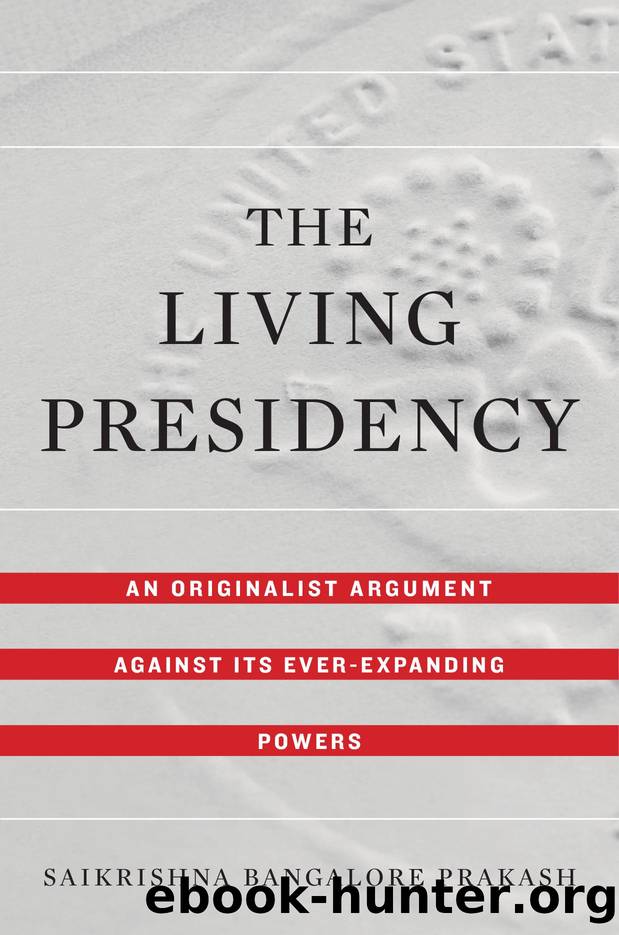
The Living Presidency by Saikrishna Bangalore Prakash
Author:Saikrishna Bangalore Prakash
Language: eng
Format: epub
Publisher: Harvard University Press
SO-CALLED UNDECLARED WARS
After the Korean War, there was some movement back to the original scheme of Congress being in charge of war. For instance, President Dwight D. Eisenhower declared that âthere is going to be no involvement of America in war [in Southeast Asia] unless it is a result of the constitutional process that is placed upon Congress to declare it.â99 Yet he sent hundreds of American advisers to train South Vietnamese troops, a tactic that his successors would sharply escalate.100 John F. Kennedy inserted thousands, and Lyndon B. Johnson, eager to use military force against North Vietnam, sent more.101 After the North Vietnamese supposedly fired upon two American vessels, Congress passed the Gulf of Tonkin Resolution, which neither âdeclared warâ nor commanded the use of force. It merely authorized an attack on North Vietnam and a defense of Southeast Asia.102
Later, many condemned Congress for not âdeclaring warâ against North Vietnam. The absence of a formal declaration supposedly made the conflict unconstitutional. Anti-war candidate Eugene McCarthy lamented, âWe donât declare war anymore, we declare national defense.â103 Decades later, similar complaints were lodged against the 2001 and 2002 Authorizations for Use of Military Force (AUMF). Congress should have âdeclared warâ against the Taliban, al-Qaeda, and Iraq, and its failure to do so signaled a constitutional failing. For many, the system was malfunctioning. Though the United States had fought many wars since World War II, it had not formally declared war since that war.
These particular critiques were (and are) without merit. First, as noted earlier, because of the way the Constitution uses âdeclare war,â an undeclared war is, by definition, impossible. All âwarsâ between nation-states are declared wars. Sometimes Congress declares them according to the constitutional process, via a bill presented to the president that eventually becomes law. Alternatively, presidents sometimes unilaterally, and unconstitutionally, declare war by attacking another nation. So, for example, the Korean War was declared by President Truman rather than Congress. Second, as noted earlier, Congress can exercise its declare-war power whether or not it uses any particular phrase. The fixation on certain words is not only pointless but also counterproductive because it draws attention away from real issues. Finally, the two Iraq Wars, and the war against al-Qaeda, were constitutional successes. In each case, Congress decided to authorize military force. Many disagree with some of these decisions and many regard these wars as failures. But at least in each case, Congress flexed its authority. For this observance of the original scheme, those Congresses should be praised, not panned.
Download
This site does not store any files on its server. We only index and link to content provided by other sites. Please contact the content providers to delete copyright contents if any and email us, we'll remove relevant links or contents immediately.
| Anthropology | Archaeology |
| Philosophy | Politics & Government |
| Social Sciences | Sociology |
| Women's Studies |
The Secret History by Donna Tartt(19466)
The Social Justice Warrior Handbook by Lisa De Pasquale(12292)
Thirteen Reasons Why by Jay Asher(9117)
This Is How You Lose Her by Junot Diaz(7056)
Weapons of Math Destruction by Cathy O'Neil(6466)
Zero to One by Peter Thiel(5951)
Beartown by Fredrik Backman(5931)
The Myth of the Strong Leader by Archie Brown(5623)
The Fire Next Time by James Baldwin(5581)
How Democracies Die by Steven Levitsky & Daniel Ziblatt(5322)
Promise Me, Dad by Joe Biden(5229)
Stone's Rules by Roger Stone(5186)
A Higher Loyalty: Truth, Lies, and Leadership by James Comey(5084)
100 Deadly Skills by Clint Emerson(5023)
Rise and Kill First by Ronen Bergman(4890)
Secrecy World by Jake Bernstein(4877)
The David Icke Guide to the Global Conspiracy (and how to end it) by David Icke(4849)
The Doomsday Machine by Daniel Ellsberg(4619)
The Farm by Tom Rob Smith(4611)
